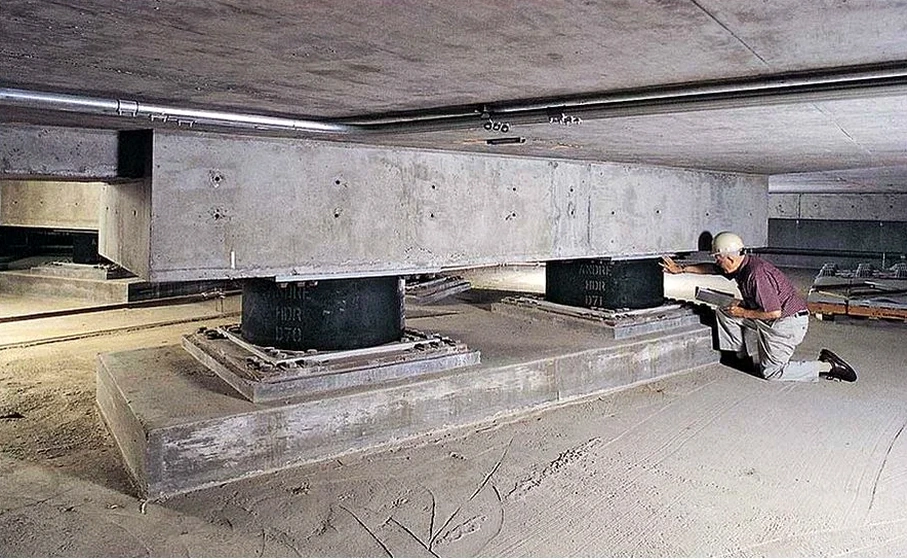
The most common mistake we see on Cape Breton Island is treating base isolation as an exclusively high-seismicity solution, then skipping it for essential facilities in Sydney or Glace Bay. The 2015 NBCC assigns spectral accelerations that, while moderate, intersect with poor soil conditions across the Bras d'Or Lowlands to create amplification scenarios that standard fixed-base designs handle poorly. We have reviewed hospital wings and emergency operations centers where the differential movement between a stiff superstructure and soft glacially-derived till would concentrate damage at the ground floor slab — exactly the failure mode isolation prevents. Our approach starts with site-specific ground motion characterization, then selects bearing parameters — often high-damping natural rubber with a 2.0 to 2.5 second isolation period — that decouple the structure from the site period while staying within the displacement capacity of the moat. For softer profiles near the Sydney Coalfield, we often recommend supplementary CPT testing to refine the shear wave velocity profile before finalizing the isolator nonlinear properties, and MASW surveys to confirm Vs30 values that govern the design spectrum.
A properly tuned isolation system shifts the structure's fundamental period beyond the site's dominant period — on Cape Breton's soft silts, that typically means targeting 2.0 seconds or longer.
Process and scope
Local context
The risk profile changes noticeably between the sandstone-founded neighborhoods of Sydney Mines and the alluvial flats near Membertou. In Sydney Mines, the competent bedrock lies within 3 to 8 meters, and isolation periods can be shorter — 1.8 to 2.2 seconds — with reliable bearing capacity beneath the isolator pedestals. Over in Membertou, we encounter 15 to 30 meters of compressible silts and clays where long-period ground motion amplification becomes the dominant concern; an isolation system tuned for a stiff-soil spectrum can actually amplify response if the site period and isolation period converge. The other Cape Breton-specific hazard is freeze-thaw degradation of the isolation moat — water ingress into the moat, followed by repeated freezing, can lock the structure to the surrounding grade and bypass the isolation plane entirely. Our detailing always includes a drained, heated moat cover system or a minimum 600 mm freeboard above the 100-year flood elevation, whichever governs. We also evaluate the potential for coal mine subsidence in the Glace Bay and New Waterford areas, where differential settlement beneath the foundation can tilt the isolator array and reduce the vertical load capacity of individual bearings — a condition that requires slope stability modeling for the underlying mine workings and often dictates a stiffer superstructure diaphragm above the isolation interface.
Reference standards
NBCC 2015 (National Building Code of Canada) – seismic provisions, Site Class determination, ASTM D4014-23 – Standard Specification for Plain and Steel-Laminated Elastomeric Bearings for Bridges, AASHTO M251-22 – Standard Specification for Sliding Bearings for Bridges and Structures, CSA A23.3-19 – Design of Concrete Structures (isolation pedestal and diaphragm detailing), ASCE/SEI 7-22 – Minimum Design Loads (isolation system testing protocols, adopted by reference).
Related services
Site-Specific Seismic Hazard & Geotechnical Investigation
We execute deep borings, CPT soundings, and MASW arrays to characterize the soil column to bedrock — typically 15 to 40 meters in the Bras d'Or basin — and develop site-specific response spectra per NBCC Article 4.1.8.12. Includes liquefaction assessment for the Mira River delta and Sydney Harbour fill zones.
Isolation System Design & Nonlinear Analysis
Complete design of lead-rubber, high-damping rubber, or friction pendulum isolation systems with 3D nonlinear time-history modeling in SAP2000 or PERFORM-3D. We size isolators, design the moat and utility crossings, and specify prototype testing sequences per ASCE 7 Chapter 17.
Prototype Testing Oversight & Construction Inspection
We witness isolator prototype tests at the manufacturer's facility — verifying effective stiffness, damping, and low-temperature performance — then provide full-time inspection during bearing installation, grouting of anchor bolts, and moat waterproofing on Cape Breton projects.
Typical parameters
Questions and answers
What is the typical cost range for base isolation design on a Cape Breton institutional building?
At what level of seismic hazard does base isolation become justified for Cape Breton buildings?
The NBCC does not prescribe a single spectral acceleration threshold; the decision balances the site class, the building's importance category, and the consequences of downtime. On Site Class D or E soils — common along the Sydney waterfront and in the Baddeck area — Sa(0.2s) values of 0.45 g or higher, combined with a post-disaster or high-importance classification, typically make isolation cost-effective compared with the damage repair costs and operational interruption of a fixed-base design over a 50-year service life.
How do you test isolators for Cape Breton's winter temperatures?
We specify low-temperature qualification per ASTM D4014, which requires the elastomer to achieve specified shear stiffness and damping within ±15% of room-temperature values after a 72-hour soak at the minimum design temperature — for Cape Breton, we set this at -30°C to cover extreme cold snaps in the Highlands. The prototype test sequence also includes scragging, full-scale dynamic cycling at design displacement, and stability checks under combined maximum vertical load and lateral offset.
Can an existing building in Glace Bay or Sydney be retrofitted with base isolation?
Yes, but the structural intervention is significant — the building must be temporarily supported on jacking columns while the ground floor columns are severed and isolators inserted. For heritage masonry structures in the North End of Sydney, we often combine isolation with a new reinforced concrete transfer diaphragm at the isolation plane. The feasibility depends on the existing foundation's capacity to accept concentrated loads under the isolator pedestals, which we verify through test pit investigations and core sampling of the existing footings.
What's the difference between lead-rubber and friction pendulum isolators for a Cape Breton site?
Lead-rubber bearings (LRBs) provide both stiffness and damping through the lead core's hysteretic behavior and work well for isolation periods up to about 2.5 seconds — suitable for most Cape Breton soil profiles. Friction pendulum systems (FPS) use a sliding interface with a spherical curvature that provides a natural period independent of the supported mass, making them attractive for lighter structures or sites where the isolation period needs to be longer — 3.0 seconds or more — to clear the site period on deep soft clay. FPS requires more solid moat detailing to handle the larger displacements and is more sensitive to installation tolerances on the sliding surface horizontality.