A recent utility tunnel alignment in the Sydney area encountered over twelve meters of compressible marine silts before reaching competent till, a scenario that forced the design team to reconsider both face pressure and settlement control measures. This is the reality of tunneling in Cape Breton, where the legacy of post-glacial deposition has left a complex stratigraphy of soft clays, silts, and organics that behaves very differently from the rock masses found elsewhere in the province. Our geotechnical analysis for soft soil tunnels addresses these conditions head-on, combining in-situ characterization with advanced laboratory testing to define strength, stiffness, and consolidation parameters that feed directly into TBM selection and support design. When the ground is this variable, you need a data set that captures the full range of behavior, not just a single borehole log. We routinely pair borehole-derived parameters with grain-size distributions to refine permeability estimates, and we rely on atterberg-limits testing to correlate plasticity with undrained shear strength profiles across the alignment.
Marine clays in the Sydney basin can lose over sixty percent of their undisturbed strength when remolded, a sensitivity that must be built into every face-support calculation.
Process and scope
Local context
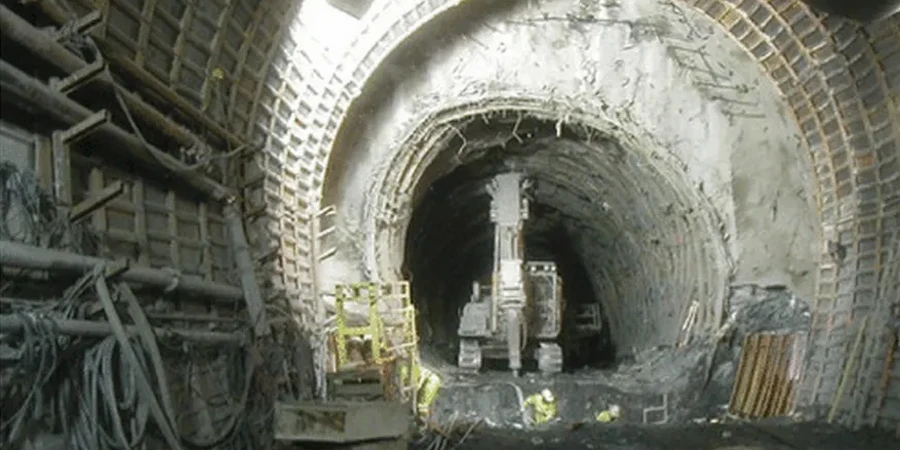
Coal mining shaped the underground landscape of Cape Breton for over two centuries, leaving a network of uncharted workings, backfilled shafts, and stress-redistributed rock mass that complicates every tunnel alignment north of the Sydney Basin. In our experience, the biggest risk is not the soft clay itself but the transition zones where a tunnel passes from stiff overconsolidated till into normally consolidated silt, a condition that generates differential settlement and can concentrate lining loads beyond what uniform-ground models predict. We address this by building three-dimensional ground models that incorporate historic mine maps, borehole break-out data, and pore-pressure response from CPTu dissipation tests. The second major risk is face blow-out under compressed-air or slurry pressure, particularly where thin sand seams connect to surface water bodies like the Northwest Arm. Our analysis quantifies the critical support pressure envelope using both effective-stress and total-stress approaches, and we always specify a factor of safety against hydraulic fracture that accounts for the low in-situ stress typical of shallow glacial valleys.
Reference standards
CSA Z317.14:18 (Geotechnical design of tunnels), ASTM D4767-11 (Consolidated-undrained triaxial compression test), ASTM D2435/D2435M-11 (One-dimensional consolidation properties), NBCC 2020 Division B Part 4 (Structural design – deep foundations and underground structures), and ASTM D5778-20 (Electronic friction cone and piezocone penetration testing) are the applicable standards.
Related services
Pre-Construction Ground Characterization
Drilling, sampling, and in-situ testing along the proposed tunnel alignment, with a focus on obtaining high-quality undisturbed samples of marine clays for laboratory strength and consolidation testing.
TBM Face-Pressure Calculation
Determination of minimum and maximum support pressure envelopes using drained and undrained parameters, incorporating the effects of surface surcharge, groundwater, and soil arching above the crown.
Settlement Trough Prediction
Empirical and finite-element modeling of short- and long-term ground movements, calibrated against consolidation data and regional experience with similar glaciolacustrine deposits in eastern Canada.
Typical parameters
Questions and answers
What is the typical cost range for a geotechnical analysis of a soft soil tunnel in Cape Breton?
How do you account for the remolded strength loss in sensitive marine clays?
We measure sensitivity directly through fall-cone and laboratory-vane tests on undisturbed samples, then apply a strain-softening constitutive model that reduces undrained shear strength as plastic shear strain accumulates around the excavation face. This ensures that the design support pressure reflects the post-peak behavior, not just the intact strength.
Can your analysis be used for both EPB and slurry TBM selection?
Yes. The grain-size distribution and plasticity data we generate feed directly into the filter-cake and paste-formation criteria that distinguish EPB from slurry applicability, and we provide the full suite of parameters needed for both machine types, including permeability, Atterberg limits, and abrasivity indices.