Cape Breton's coastal environment presents a unique set of challenges for deep excavation and slope stabilization, where the choice between active and passive anchor systems can determine the long-term performance of a structure. The island's geology, shaped by the Bras d'Or Lake fault system and Pleistocene glaciation, creates a patchwork of competent granites, fractured sedimentary rocks, and saturated glacial tills that demand a rigorous design approach. Anchor systems installed along the Cabot Trail or near the Sydney coalfields must contend with aggressive groundwater chemistry, freeze-thaw cycles down to 1.2 m depth, and residual stresses in the rock mass. A design that works reliably in the Horton Group sandstones of the west coast may prove inadequate in the Malagawatch Formation shales further east, which is why every anchor bond length calculation starts with site-specific geotechnical data rather than regional assumptions. Before finalizing anchor geometry, the engineering team often integrates findings from slope stability modeling to verify global failure surfaces, and may specify footings where anchor loads transfer to spread foundations in mixed soil-rock profiles.
Anchor bond capacity in Cape Breton's rock formations can vary by a factor of three within a single excavation, demanding a design that adapts to real-time geological data rather than idealized profiles.
Process and scope
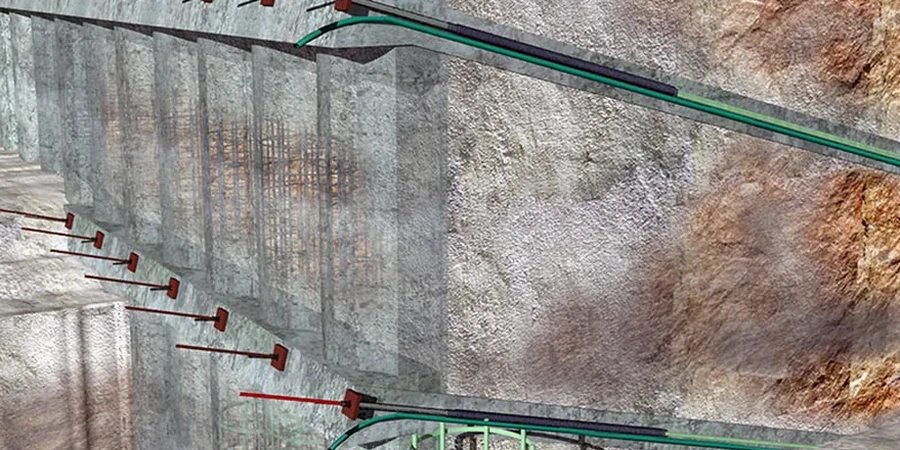
Local context
The glacial stratigraphy of Cape Breton introduces a risk factor that generic anchor designs fail to address: the presence of boulder-rich lodgement till directly overlying soft, compressible water-lain sediments. When anchor bond zones are placed across this contact without adequate investigation, differential creep can lead to progressive load transfer to the anchor head and eventual loss of pre-stress in active systems. Groundwater chemistry also plays a decisive role, with pH values as low as 4.8 recorded in the Sydney coalfield region, accelerating corrosion rates in unprotected steel tendons. A documented case from a highway cut near Baddeck involved passive anchors in shale that lost 40% of capacity within five years due to pyrite oxidation and acidic seepage. The design team now mandates electrochemical testing of groundwater for any permanent anchor installation east of the Bras d'Or Lakes, and specifies fully encapsulated strand tendons with factory-applied epoxy coating in aggressive environments. Performance monitoring through load cells and inclinometers remains essential for all Category 1 structures.
Reference standards
The design of active and passive anchors in Cape Breton's complex terrain must adhere to multiple technical standards, including CSA A23.3-14 Annex D for anchorage design and PTI DC35.1-14.
Related services
Anchor Feasibility and Bond Length Calculation
Site-specific bond stress determination using pressuremeter data and rock core recovery indices, with capacity verification against CSA A23.3 limit states.
Active Tieback Design for Deep Excavations
Prestressed anchor systems for urban cuts, including staged excavation sequencing, lock-off load specification, and long-term relaxation analysis.
Passive Anchor and Soil Nail Reinforcement
Self-drilling and open-hole passive anchors for natural slope stabilization, with sacrificial steel thickness calculations for corrosion-prone environments.
Proof Testing and Performance Monitoring
On-site load testing per PTI recommendations, including creep monitoring, lift-off verification, and automated load cell data logging for critical structures.
Typical parameters
Questions and answers
What distinguishes active from passive anchors in terms of construction sequence?
Active anchors are stressed to a predetermined lock-off load immediately after grout reaches sufficient strength, typically within 7 days, which controls wall deflections from the start. Passive anchors develop resistance only as the ground moves, so the construction sequence must accommodate initial deformation before the system reaches full capacity. This makes active systems mandatory where adjacent structures within the zone of influence require settlement protection.
How does Cape Breton's geology affect anchor bond length design?
The island's variable geology requires distinct bond stress assumptions: competent granodiorite in the Creignish Hills may sustain 1.0-1.5 MPa at the rock-grout interface, while fissile shales of the Mabou Group and saturated tills near Bras d'Or Lakes rarely exceed 60-100 kPa. Each anchor bond zone must be evaluated against actual recovered core and pressuremeter data, not just regional mapping, because lithological transitions occur abruptly across the island's fault-block terrain.