The geology of Cape Breton splits the island into two distinct worlds. Around Sydney, you hit the Carboniferous basin with its coal measures and thick compressible clays, while the Highlands to the west give you weathered granite and till over bedrock that refuses to settle evenly. A warehouse foundation near North Sydney faces a completely different soil profile than a transmission tower on the Cabot Trail. For both, we apply vibrocompaction where granular deposits are loose to medium-dense, and shift to stone column design when we need to reinforce soft cohesive layers that cannot drain effectively. The island's post-glacial history left behind marine silts and organic pockets that demand more than a textbook approach. Our team has worked across the CBRM and rural Inverness County, adapting aggregate pier geometries to local stratigraphy every time.
A well-designed stone column grid can reduce total settlement by 40 to 60 percent in Cape Breton's soft clays, without the carbon footprint of deep foundations.
Process and scope
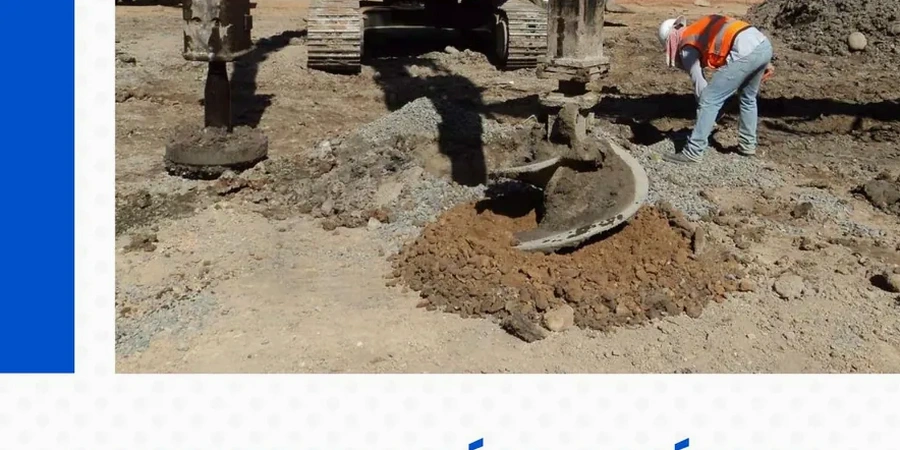
Local context
NBCC 2015 Part 4 and the referenced CSA A23.3 set the performance bar for foundations on improved ground, and in Cape Breton the seismic hazard is not negligible. The 2020 national seismic hazard model assigns a PGA around 0.10 to 0.15g for Sydney on firm ground, but site class E soils amplify that significantly. Stone columns designed purely for static settlement risk liquefaction-induced loss of confinement if the silts between columns are not assessed. We run SPT-based liquefaction triggering analysis per Youd-Idriss (2001) and confirm the factor of safety against cyclic softening. Where the post-liquefaction residual strength drops below 5 kPa, we tighten the column grid and add a load-transfer platform with geogrid reinforcement. Bulging failure near the top 2 to 3 diameters is the most common limit state we check, especially under wide-area loads like tank farms. Every design includes a deformation analysis, not just bearing capacity, because serviceability governs in these soils.
Reference standards
The design of stone columns in Cape Breton for ground improvement of glacial soils references NBCC 2015 Part 4 for structural design, CSA A23.3:2014 for concrete structure foundation provisions, ASTM D1586-18 for standard penetration testing, and the Youd-Idriss 2001 NCEER procedures for liquefaction triggering assessment.
Related services
Feasibility and Preliminary Design
Desktop review of geotechnical reports, CPT logs, and groundwater data to confirm stone column suitability. We produce a preliminary layout with estimated replacement ratio, depth, and settlement reduction. Includes a budget-level stone quantity estimate for contractor pricing.
Detailed Design and Installation Supervision
Full design package with column grid coordinates, diameter, length, stone specification, and acceptance criteria. We provide on-site supervision during trial column installation and production, adjusting design based on real-time amperage and penetration data.
Typical parameters
Questions and answers
What does stone column design cost for a project in Cape Breton?
How do you verify that stone columns perform as designed?
We specify post-installation CPT soundings through the column center and at mid-distance between columns to check composite strength. In critical structures we may require a zone load test on a group of columns with settlement monitoring over 48 hours. Amperage and stone volume records from installation also feed into the verification report.
Can stone columns work in Cape Breton's glacial till?
Stone columns are not needed in dense glacial till because the soil already has adequate bearing capacity and stiffness. They are designed for the soft clays and loose silts that overlie the till. The column tip bears into the till layer, transferring load to competent ground while reinforcing the soft upper strata.
What is the minimum site investigation needed before stone column design?
We need at least one CPT or SPT boring per 400 m² of treatment area, extending 3 meters below the expected column tip. Lab tests must include Atterberg limits, grain-size distribution, and undrained shear strength of the soft layer. Groundwater level must be recorded. Without this data, the replacement ratio and settlement estimates are unreliable.