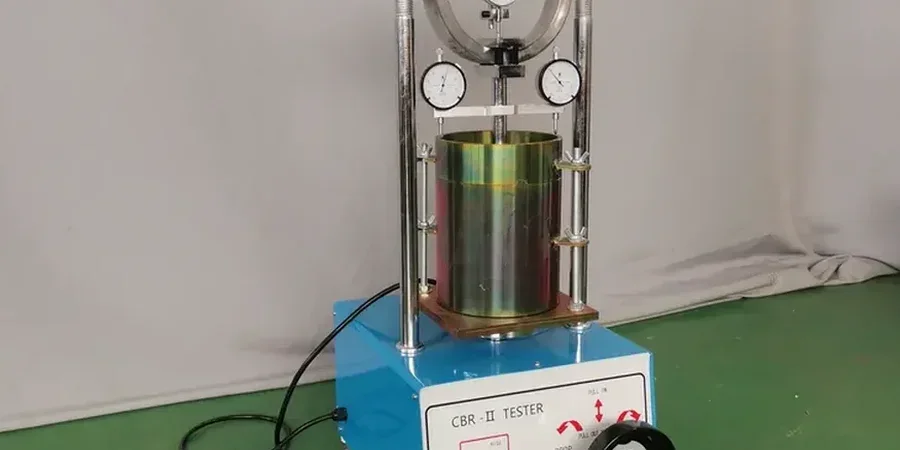
The Canadian Foundation Engineering Manual and ASTM D1883 provide the framework, but in Cape Breton, applying the laboratory CBR test requires more than a standard procedure. The island's complex glacial stratigraphy, mapped by the Nova Scotia Geological Survey, places dense Lawrencetown till directly against soft, wet basins of silt and organic deposits, sometimes within the span of a single subdivision road. A soaked CBR value that holds on a bench sample can fall apart in a pocket of compressible clay just meters away. Our laboratory team works exclusively with samples extracted by experienced drill crews who understand Cape Breton's erratic ground: bedrock strikes at three meters in Sydney River while drillers sink twenty meters through saturated silts in the Mira River floodplain. This local sampling discipline, combined with the CBR test under modified Proctor moisture conditioning, provides pavement designers with a bearing capacity ratio that reflects actual seasonal extremes, not generic assumptions. Complementing the California bearing ratio with a full grain size analysis helps identify whether fines migration will further weaken the base course during spring thaw, and many Cape Breton projects benefit from running Atterberg limits in parallel to flag any plasticity that might compromise the soaked CBR reading.
A soaked CBR value measured on undisturbed Cape Breton till tells the pavement designer more about spring load capacity than any textbook correlation ever could.
Process and scope
Local context
Cape Breton's Wisconsinian glacial footprint left the island with a patchwork of dense lodgement till, ablation moraine, and soft postglacial marine silts that rise nearly to sea level along the Bras d'Or Lakes shoreline. When a pavement design relies on a laboratory CBR test taken from one borehole, the project accepts a gamble: the next thirty meters of alignment might sit on a completely different deposit with half the bearing capacity. The CBRM's infrastructure records document recurring pavement distress on collector roads crossing infilled valleys, where the laboratory CBR of the fill material tested years ago has degraded as fines migrated and drainage patterns changed. Contractors who skip site-specific CBR testing often discover in May what the frost boil season reveals: a subgrade with a soaked CBR of two or three percent cannot support the design ESALs without a complete structural section rebuild. The economics of pavement reconstruction on Cape Breton's constrained municipal budgets make the upfront cost of a comprehensive laboratory CBR testing program — with specimens prepared at multiple moisture contents and densities — a fraction of the lifecycle expense of premature fatigue cracking and rutting.
Visual overview
Reference standards
The relevant standards for the laboratory CBR test include ASTM D1883-21, ASTM D1557 (Modified Proctor), AASHTO T 193, and Nova Scotia TIR Standard Specification 301.
Related services
Soaked and Unsoaked CBR Comparison
Specimens compacted at optimum moisture and tested both immediately and after 96-hour soaking, quantifying the strength loss ratio that governs Cape Breton's spring load restriction planning. The difference between unsoaked and soaked CBR often exceeds 40 percent in local silty tills.
CBR with Swell Measurement
During the soaking phase, vertical swell is recorded daily using a tripod dial gauge mounted on the mold collar. Cape Breton clay-rich tills can exhibit 2 to 5 percent swell, a critical input for pavement sections over moisture-sensitive subgrades near the Mira River.
Multi-Point Compaction CBR Curves
Three CBR specimens compacted at 90, 95, and 100 percent of maximum dry density produce a compaction-versus-CBR curve that allows the contractor to evaluate the cost-benefit of additional rolling passes versus a thicker granular base layer.
Laboratory CBR for Chemically Stabilized Soils
Cape Breton road projects increasingly specify lime or cement stabilization of wet subgrades. CBR specimens are prepared with the stabilizer dosage, cured for seven days at 40 degrees Celsius, then soaked and penetrated to verify the strength gain meets the design threshold.
Typical parameters
Questions and answers
How much does a laboratory CBR test cost in Cape Breton?
How long does the laboratory CBR test take from sample delivery to report?
The minimum turnaround is seven working days: one day for compaction curve development and specimen molding, four days of monitored soaking with swell readings, one day for the penetration test and data reduction, and one day for the engineering report. Rush processing can compress this to five days when project schedules demand it.
Why is the soaked CBR more relevant than the unsoaked value for Cape Breton roads?
Cape Breton's average annual precipitation exceeds 1,400 millimeters, and spring snowmelt saturates the pavement subgrade for weeks. The soaked CBR test simulates this worst-case moisture condition by submerging the specimen for 96 hours. Pavement thickness designs based on unsoaked CBR values consistently underperform during the March-April thaw period when subgrade support is at its minimum.
Can the laboratory CBR test be performed on samples with gravel larger than 20 millimeters?
ASTM D1883 limits the maximum particle size to 19 millimeters for the standard 152.4 mm mold. When the field sample contains oversize cobbles common in Cape Breton glacial tills, the material is scalped on the 19 mm sieve and a correction is applied, though results become conservative. For materials with significant plus-19 mm content, the laboratory will recommend complementary gradation analysis and possibly a field CBR test for correlation.