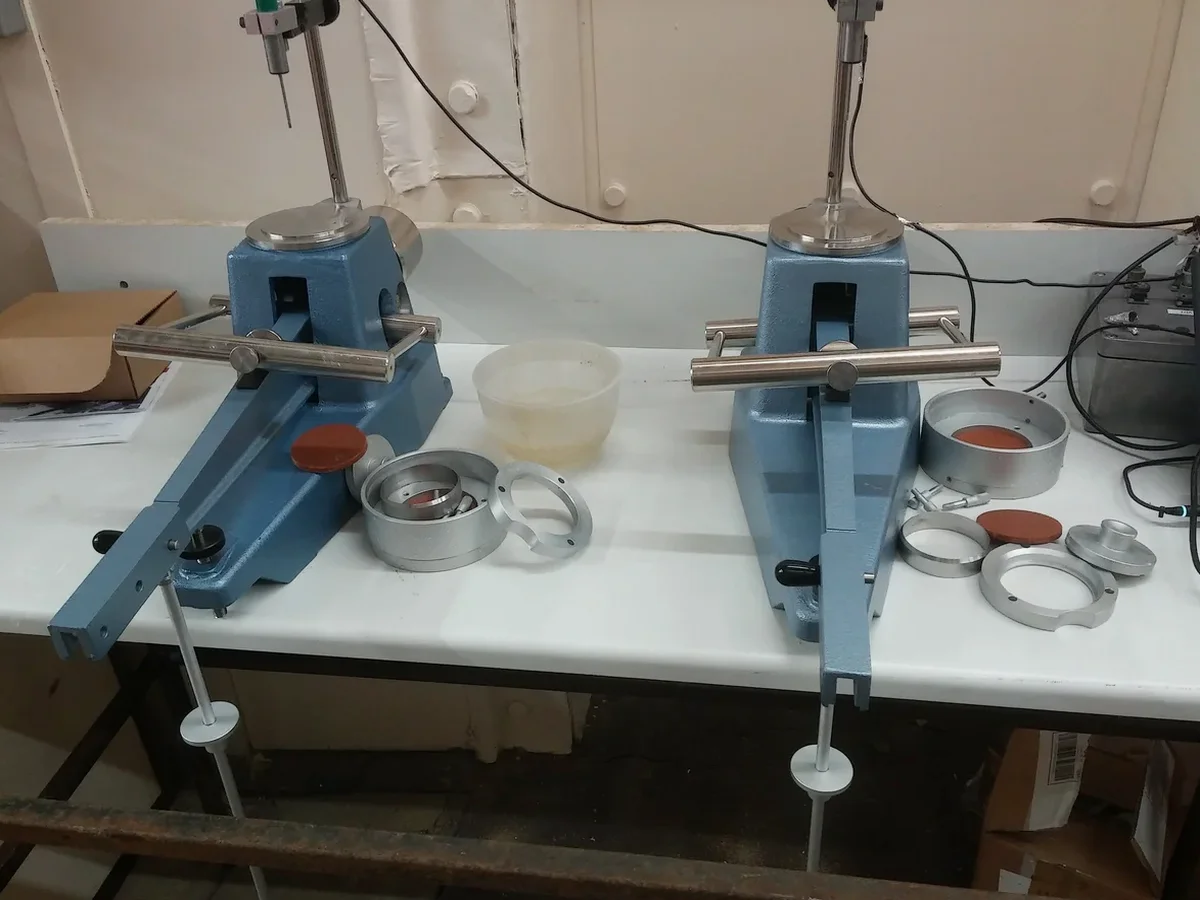
ASTM D4318 compliance starts long before a foundation is poured, and in Cape Breton the need is amplified by a geological history that stacked glacial till over soft Carboniferous bedrock. The Atterberg limits define the moisture boundaries where fine-grained soil changes from solid to plastic to liquid, and missing those transitions on a Sydney-area site can turn a straightforward excavation into a stability problem. The liquid limit and plastic limit numbers feed directly into the Unified Soil Classification System, which dictates allowable bearing pressures under the National Building Code of Canada. Our laboratory runs the Casagrande cup method alongside the plastic limit thread-rolling procedure, producing a plasticity index that geotechnical engineers use to forecast volume change potential. For coastal lots from Glace Bay to Port Hawkesbury, where marine silt layers appear unpredictably, pairing the limits with a grain-size analysis clarifies whether the fines are silt or active clay. When the plasticity index exceeds 15, we often recommend cross-checking the results against in-situ permeability to understand drainage implications for footings.
A plasticity index above 12 in Cape Breton glacial till signals active clay minerals that can swell under a wet spring and shrink during a dry summer.
Process and scope
Local context
Soil behavior diverges sharply between the Sydney coalfield basin and the granite-dominated highlands west of the Bras d'Or Lake. In the Whitney Pier and Ashby neighborhoods, fill overlying marine silts frequently shows a liquid limit above 45 and a plasticity index exceeding 20—these are moderately plastic silts that lose strength rapidly when saturated, a condition observed during the 2016 Thanksgiving flood. Contrast that with the well-drained tills around Howie Centre, where the liquid limit drops below 30 and the plasticity index hovers between 5 and 10, indicating silt with low plasticity and far less heave risk. The difference means a pier-and-grade-beam design acceptable in one postcode may be unsafe two kilometers away. Our lab flags any sample plotting above the A-line on the Casagrande plasticity chart as a clay of high compressibility, triggering a recommendation for consolidation testing before finalizing foundation elevations.
Reference standards
ASTM D4318-17: Standard Test Methods for Liquid Limit, Plastic Limit, and Plasticity Index of Soils; ASTM D2487-17: Standard Practice for Classification of Soils for Engineering Purposes (Unified Soil Classification System); CSA A23.3: Design of Concrete Structures (incorporating soil classification for foundation design); and NBCC 2015 Division B, Section 4.2: Foundation requirements based on soil type.
Related services
Grain Size Analysis by Sieve and Hydrometer
Full ASTM D422/D6913 particle distribution from coarse gravel to clay fraction, essential for classifying Cape Breton glacial tills.
Natural Moisture Content
Oven-dry determination per ASTM D2216, providing the in-situ water content needed to interpret Atterberg limit results.
Specific Gravity of Solids
ASTM D854 pycnometer testing that supplies the Gs value for hydrometer analysis and void ratio calculations.
Organic Content by Loss on Ignition
ASTM D2974 method at 440°C, critical for identifying organic silts in low-lying areas near the Sydney harbor and Mira River floodplain.
Typical parameters
Questions and answers
What moisture conditions does the Atterberg test actually measure?
The test determines two boundaries: the liquid limit is the moisture content where soil transitions from plastic to liquid behavior under 25 blows of the Casagrande cup, and the plastic limit is the moisture content where a 3-millimeter thread begins to crumble. The plasticity index (LL minus PL) quantifies the moisture range over which the soil stays plastic. These values classify fine-grained soils per ASTM D2487 and predict how much a soil will shrink or swell as water content changes through Cape Breton's freeze-thaw cycles.
How much does Atterberg limits testing cost in Cape Breton?
Does Cape Breton glacial till always need Atterberg testing?
Not always, but it becomes mandatory when visual classification suggests more than 12% fines passing the No. 200 sieve. The CBRM's variable till matrix—ranging from sandy silt to silty clay depending on the drumlin deposit—makes a plasticity index essential for foundation design. Our lab recommends running Atterberg limits on any Cape Breton site where the natural moisture content exceeds 20% and the soil feels smooth rather than gritty when rubbed between fingers.
What sample preparation do you require for the Atterberg limits test?
We need approximately 150 grams of material passing the No. 40 (425-micrometer) sieve, prepared from a representative disturbed sample. For Cape Breton projects, we prefer receiving a one-gallon bag of the bulk material so our technicians can perform the sieving and splitting in-house under ASTM D421 procedures. Samples should be sealed immediately after extraction to preserve natural moisture; dried-out samples bias the liquid limit low and produce misleading plasticity indices.