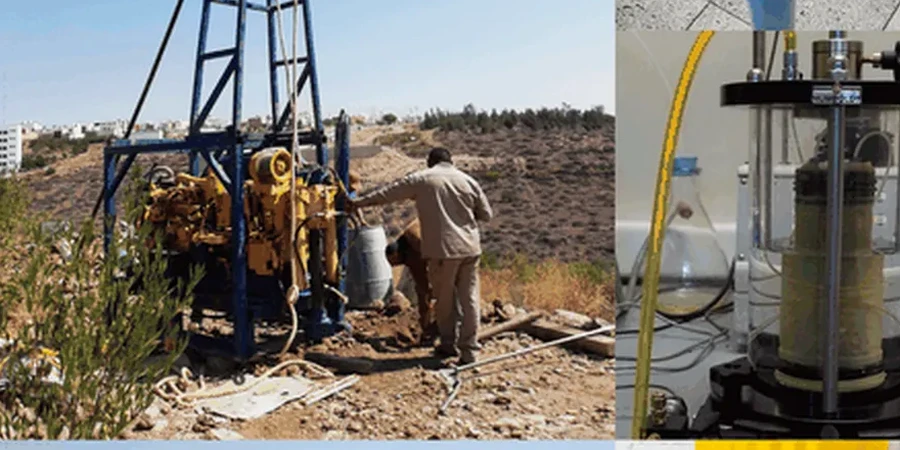
The difference between building near the sandstone bluffs of Sydney Mines and the glacial till plains of Baddeck comes down to the soil's story. In Cape Breton, every construction site inherits a complex geological past shaped by ancient oceans and retreating ice sheets. A proper soil mechanics study reads that history, translating it into bearing capacities and settlement predictions. The local terrain can shift from dense basal till to soft marine clay within a single lot, a variability that demands more than a generic site investigation. Our laboratory works with drillers and excavation contractors across Cape Breton to extract, preserve, and test samples under ASTM standards. For deeper bedrock profiles common on the island, we often pair laboratory analysis with field spt-drilling to quantify resistance at depth, ensuring the foundation design isn't guessing at what lies beneath the overburden.
Understanding Cape Breton's soil means recognizing that a single borehole log rarely tells the full story of a glacially overridden landscape.
Process and scope
Local context
We often see foundation distress in older Cape Breton neighborhoods where builders underestimated the consolidation settlement of marine silts underlying a thin sand crust. These soft deposits, common in the filled shorelines of Glace Bay and North Sydney, can settle for decades under relatively light structural loads, cracking masonry and binding doors. A soil mechanics study that skips oedometer testing on these materials misses the primary risk driver. The other recurring issue involves bearing capacity failures in cuts through weathered shale: what looks like competent bedrock on an excavator bucket can rapidly degrade into slickensided fragments when exposed to repeated wet-dry cycles. Our laboratory program quantifies the slake durability and shear strength reduction of these local shales so that footing elevations and slope angles are set with a conservative, weathered-state profile in mind, not just the fresh rock properties. Ignoring the chemical aggressivity of the soil, particularly sulfate attack on concrete, is another costly oversight we help contractors in Cape Breton avoid through targeted water-soluble ion testing.
Reference standards
Geotechnical investigations in Cape Breton adhere to ASTM D4767 for triaxial testing, ASTM D2435 for consolidation, ASTM D422 for grain size analysis, NBCC 2015 Division B Part 9, and CSA A23.3 for foundation concrete exposure conditions.
Related services
Foundation Design Parameter Suite
Complete set of index and strength tests—moisture content, Atterberg limits, unit weight, direct shear or triaxial—calibrated for shallow footing and mat foundation design on Cape Breton tills and residual soils.
Settlement and Slope Stability Analysis
Consolidation tests on Shelby tube samples from compressible estuarine clays plus residual shear strength testing on shale-derived colluvium; data used directly in geotechnical modeling for cut slopes and embankments.
Typical parameters
Questions and answers
What is the typical turnaround time for a soil mechanics study on a Cape Breton residential lot?
Standard laboratory tests including index properties, grain size, and a suite of shear strength measurements typically require 10 to 15 business days after sample receipt. Consolidation tests, which can run for a week or more depending on clay permeability, extend the schedule. We coordinate directly with the local drilling crew to stage sample delivery and can fast-track critical parameters when the excavation permit clock is ticking.
How much does a comprehensive soil mechanics study cost for a Cape Breton building project?
Does the lab hold any third-party accreditation for its testing procedures?
Yes, the laboratory is accredited to ISO/IEC 17025 for the ASTM test methods listed in our scope of accreditation. All testing equipment undergoes regular calibration traceable to NIST, and our quality control program includes blind duplicate testing and reference material verification. Reports are signed by a professional engineer licensed to practice in Nova Scotia.