Cape Breton's geological story is written in ice and ocean. The island's subsurface reflects multiple glacial advances that scraped bedrock clean, then dropped chaotic blankets of till, followed by marine inundation that deposited sensitive clays in the Bras d'Or lowlands. When you drill here you encounter everything from dense granitic lodgement till to soft estuarine silts within twenty vertical meters. Conventional sampling alone rarely captures the full picture. The CPT cone penetration test provides continuous, high-resolution data that reveals exactly where these transitions occur, something our team has relied on repeatedly when characterizing sites from Sydney to the Margaree Valley. For projects where glacial stratigraphy controls foundation decisions, this test often becomes the primary investigation tool rather than a supplementary one. Before committing to a full drilling program, many engineering firms combine an initial CPT profile with targeted SPT drilling to calibrate the cone data against recovered samples in critical layers.
The CPT's continuous soil behavior profile eliminates the blind zones between split-spoon samples, which is critical in Cape Breton's rapidly changing glacial stratigraphy.
Process and scope
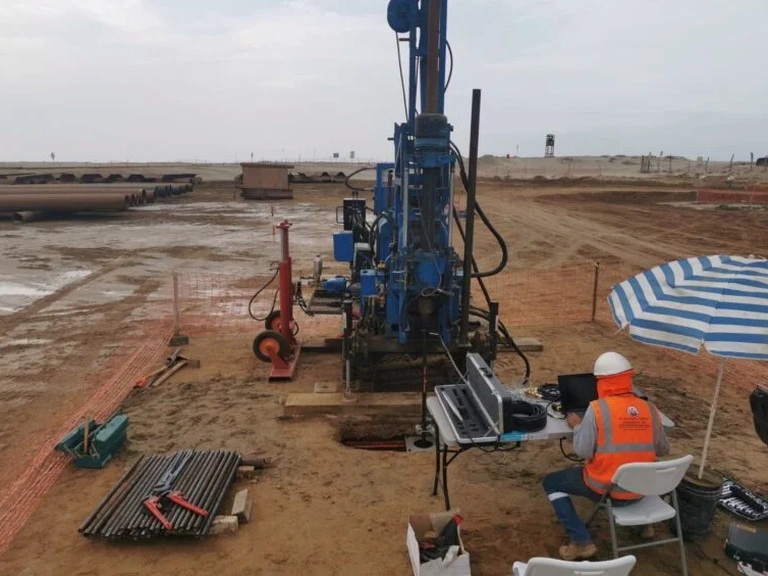
Local context
The Bras d'Or Lake lowlands contain extensive deposits of post-glacial marine clay that can exhibit sensitivity values exceeding 30, meaning undisturbed samples are essential for strength testing but notoriously difficult to obtain. The CPT overcomes this by measuring in-situ undrained shear strength through the cone factor relationship without disturbing the soil fabric. The real risk we encounter in Cape Breton is the abrupt interface between dense basal till and weathered bedrock, a contact that can damage cone tips if not anticipated. Our operators monitor the penetration rate and sleeve friction in real time, pre-drilling through fill or cobble layers when the friction ratio signals refusal risk. In the Sydney coalfields region, abandoned mine workings and uncontrolled backfill create additional hazards that the CPT can detect through sudden loss of tip resistance or erratic pore pressure response, providing early warning before more expensive drilling equipment is committed to the borehole.
Reference standards
The methodology adheres to ASTM D5778-20 for electronic friction cone and piezocone penetration testing, complies with NBCC 2020 Division B Part 4 for geotechnical investigation requirements, follows CSA A23.3-19 for foundation provisions referencing in-situ testing, and references Robertson & Cabal (2015) for cone penetration testing in geo-environmental applications.
Related services
Standard CPT Sounding
Single piezocone sounding to target depth with real-time soil behavior type classification. Ideal for preliminary site screening and foundation feasibility on residential or light commercial lots.
CPT with Pore Pressure Dissipation
Includes dissipation tests at preselected depths to evaluate consolidation characteristics of clay layers. Essential for settlement analysis in the Bras d'Or marine clay belt and estuarine zones.
Multi-Point CPT Investigation
Grid or transect of soundings across the site with cross-section interpretation. Recommended for variable glacial terrain, reclaimed mine land, or projects where stratigraphic continuity must be verified.
Typical parameters
Questions and answers
What depth can CPT achieve in Cape Breton glacial till?
Penetration depth depends entirely on till density and the presence of cobbles or boulders. In the dense lodgement till common across Cape Breton's uplands, refusal often occurs between 8 and 15 meters when tip resistance exceeds 50 MPa. In softer marine and alluvial deposits of the Bras d'Or lowlands, soundings routinely reach 25 to 30 meters. We monitor sleeve friction and pore pressure continuously to decide when pre-drilling or refusal termination is warranted.
How much does CPT testing cost on Cape Breton Island?
Can CPT replace boreholes completely for foundation design?
CPT provides continuous soil behavior data that often exceeds the information density of conventional boreholes, but it does not recover physical samples for laboratory testing. In Cape Breton practice, the most efficient approach is a paired investigation: CPT soundings to map stratigraphic continuity between strategically placed boreholes that provide samples for index testing, shear strength, and consolidation analysis. The CPT data then allows interpolation between sample points with confidence.
How do you interpret soil type from CPT data alone?
We use the normalized Soil Behavior Type (SBT) classification system developed by Robertson, which plots normalized tip resistance against normalized friction ratio. The chart divides soils into zones ranging from sensitive fine-grained soils to sands and gravels. This classification is calibrated against local Cape Breton geology, where the transition from marine clay to glacial till produces a distinctive signature on the SBT plot that our engineers recognize from hundreds of previous soundings across the island.