Designing a retaining wall between North Sydney's weathered bedrock and the thick marine silts near Glace Bay demands two fundamentally different engineering approaches. Cape Breton's glacial history left behind a patchwork of ground conditions: dense lodgement till overlying sedimentary rock on one hillside, loose ablation till and compressible organic layers just a few kilometers away. Homeowners expanding a driveway on a slope in Sydney River face lateral earth pressures and drainage headaches that a flat-lot foundation in Baddeck simply never encounters. The team behind this work has spent years correlating surficial geology maps with actual borehole logs across the island, and that local calibration matters when selecting wall type, reinforcement, and footing geometry for sites where bearing capacity can shift dramatically within a single property.
A retaining wall in Cape Breton is not a catalogue item. It is a drainage structure first and a structural element second, designed for the storm that arrives while the ground is still half-frozen.
Process and scope
Local context
Sydney's steel-plant boom and the post-war subdivision rush left Cape Breton with a legacy of cut-and-fill terracing that rarely had engineered retaining structures. Old timber crib walls, now rotting, hold back slopes that were never properly drained. When these fail, the debris flow can reach public roads and neighbouring foundations. A new wall on a previously developed site often means dealing with uncontrolled fill containing slag, ash, boulders, and buried organics: material that offers wildly inconsistent shear strength. We approach these jobs with a forensic mindset, mapping old aerial photos from the Beaton Institute archive against current LiDAR topography to identify fill boundaries before the first test pit is even dug.
Reference standards
The applicable standards include NBCC 2020 Division B Part 4 (Structural).
Related services
Residential & Hillside Retaining Walls
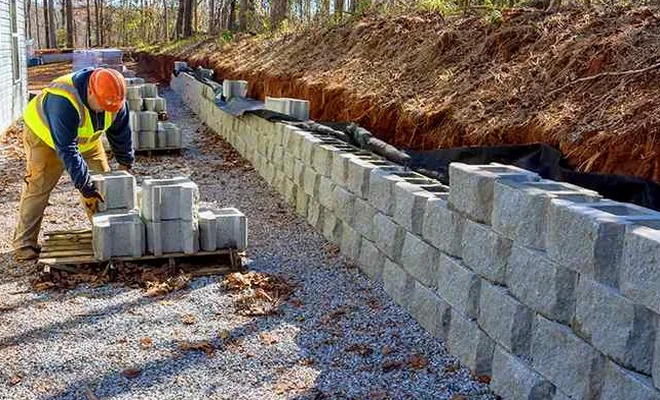
Gravity block walls, cast-in-place cantilevered walls, and reinforced slopes for homes in areas like Coxheath, Mira, and Georges River. Designs include frost-protected footings, subdrain detailing, and coordination with lot-grading plans approved by CBRM Engineering.
Infrastructure & Shoreline Protection
Anchored soldier pile walls and mechanically stabilized earth (MSE) structures for roadway widenings, bridge abutments, and coastal erosion control along the Bras d'Or Lake shoreline. Hydraulic modeling of wave run-up and scour depth informs embedment requirements.
Typical parameters
Questions and answers
What does retaining wall design cost in Cape Breton?
Do I need a building permit for a retaining wall on my property?
Within the Cape Breton Regional Municipality, walls over 0.9 meters in height generally require a development permit and must be designed by a qualified professional. Walls retaining surcharge loads from driveways or buildings, regardless of height, also trigger engineering review. Always confirm current CBRM Land Use Bylaw requirements before starting excavation.
What type of retaining wall works best for the freeze-thaw conditions here?
Cantilevered reinforced concrete walls with a granular backfill chimney drain and a free-draining base course consistently outperform other types in Cape Breton's climate. The key is preventing water from ponding behind the wall during freeze-thaw cycles. Gravity walls can work well in lower cuts if founded below the design frost depth, but they require careful compaction of each lift to avoid differential movement during spring thaw.