Between the hard-packed glacial drumlins around Sydney and the soft estuarine silts lining the Bras d'Or Lakes, Cape Breton presents two completely different geotechnical profiles within a 20‑minute drive. On the north side of the island, footings often bear directly on dense till with allowable pressures reaching 250 kPa, while projects along the Mira River or near the North Sydney waterfront encounter compressible organic layers that demand wider pads and controlled backfill placement. We have pulled split‑spoon samples from dozens of sites across the Cape Breton Regional Municipality, and the contrast between the highlands and the coastal flats is something that a generic foundation table simply cannot capture. A shallow foundation that works in Membertou might fail a settlement check in Glace Bay, which is why we tie every design back to measured stratigraphy rather than assumed bearing values. When the overburden includes sensitive marine clay, we often pair the investigation with an in‑situ permeability test to understand how groundwater will interact with the footing subgrade during spring thaw.
A shallow foundation in Cape Breton is only as reliable as the frost‑depth measurement and the till classification that sit behind it.
Process and scope
Local context
On the coastal side of Route 4 between Sydney and Glace Bay we frequently encounter a thin crust of stiff clay over softer, normally consolidated material. A shallow foundation sized for the crust will settle excessively once the load bulb reaches the weaker layer, and the owner ends up with racked doors and cracked gypsum board within two heating seasons. The other recurring problem is groundwater perched in the weathered zone above the till‑bedrock interface; we have measured pore pressures high enough to reduce effective stress by 40 percent during a wet November, which is why we insist on sub‑drainage details even for apparently dry sites. Frost jacking of unheated attached garages is another local classic, especially on north‑facing slopes where the snow cover is thin and the frost penetrates deeper than the code minimum. These are all avoidable failures if the design accounts for the full stratigraphic column, not just the top 1.5 metres.
Reference standards
The design of shallow foundations in Cape Breton ad
Related services
Bearing Capacity and Settlement Analysis
We calculate allowable bearing pressure using limit equilibrium methods and check total plus differential settlement against the NBCC serviceability criteria. The analysis incorporates the actual groundwater level measured during drilling, not an assumed depth.
Footing Geometry and Reinforcement Detailing
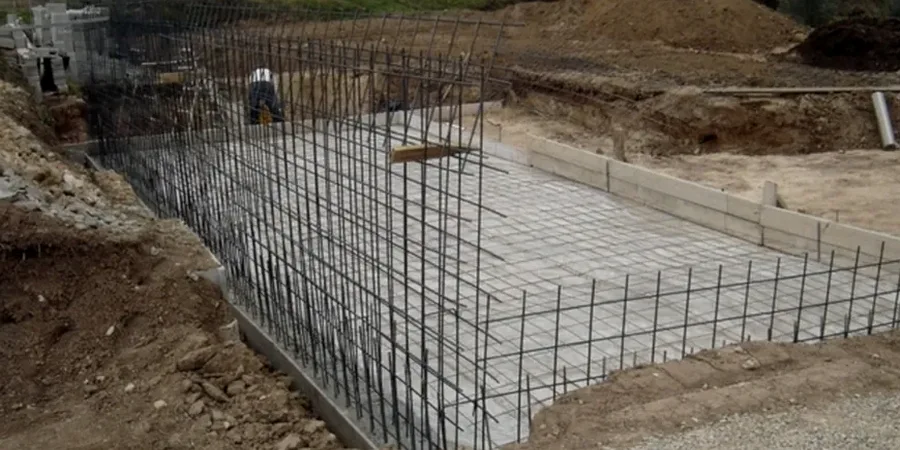
Strip, pad, and stepped footings are dimensioned for the specific soil profile at each column line. We produce bar‑bending schedules and lap‑splice details that comply with CSA A23.3 and are buildable by a local crew using standard 10M or 15M bars.
Frost Protection and Sub‑Drainage Design
We specify insulation configurations, skirt depths, and perimeter drain layouts that keep the subgrade above freezing. For sites with perched water we design a graded filter blanket and collector pipe network tied into the storm system.
Typical parameters
Questions and answers
How deep do footings need to go in Cape Breton to stay below the frost line?
The NBCC sets a minimum cover of 1.2 m for most of Cape Breton, but that assumes a normal snow‑cover winter and mineral soil. On exposed hilltops or in silty soils with high frost susceptibility we extend the base to 1.5 m or add rigid insulation beneath the slab to keep the 0°C isotherm above the bearing stratum.
Can you design a shallow foundation on the old backfilled land near the Sydney waterfront?
Yes, but it requires a careful investigation. Much of the fill contains coal‑mine waste, ash, and rubble with variable compaction. We typically run CPT soundings or dense SPT grids to map the fill thickness, then either excavate and replace the upper layer or widen the footings to bridge soft pockets while keeping differential settlement within tolerable limits.
What is the typical cost for shallow foundation design on a residential lot in Cape Breton?
Do you use the same bearing pressure for strip footings and pad footings?
No. Strip footings benefit from plane‑strain confinement and can often be assigned a slightly higher allowable bearing pressure than an isolated pad footing of the same width. We evaluate each case with separate Terzaghi or Meyerhof bearing‑capacity factors, and we reduce the pressure where the footing is within 1.5 m of a slope crest, which is a common situation on Cape Breton hillside lots.