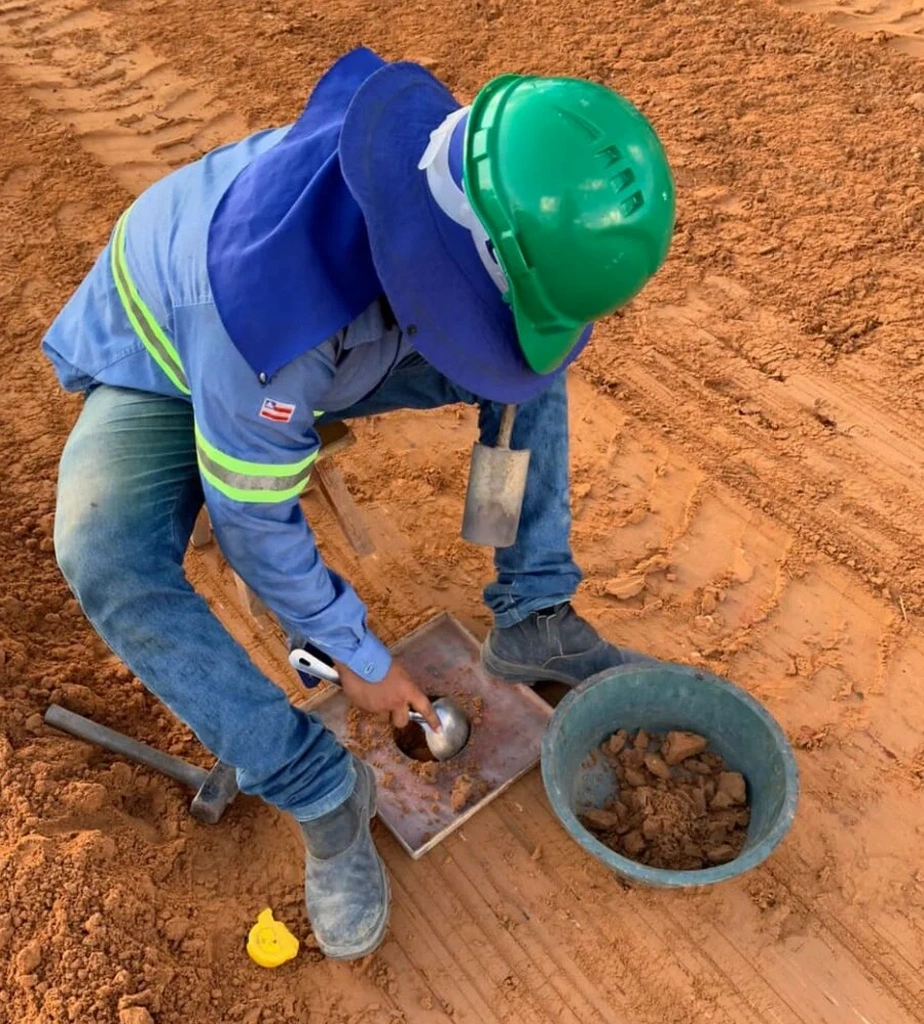
Overlooking density testing on Cape Breton’s compacted fills leads to settlement cracks within the first freeze-thaw cycle. The island’s native glacial till — a dense mix of silt, sand, and cobbles — can feel firm under the roller but still hide 8-12% air voids if lift thickness isn’t matched to compactive effort. Building officials in CBRM and Victoria County routinely request density reports tied to ASTM D1556 before signing off on foundation backfill or utility trench reinstatement. Our team runs the sand cone test directly on prepared surfaces, weighing field samples to 0.1 g precision, and delivers a comparison against laboratory maximum dry density from Proctor tests within 24 hours. For roadbase layers along the Trans-Canada corridor near Baddeck, we often pair sand cone readings with CBR evaluation to confirm both compaction and bearing capacity in the same inspection window.
A sand cone test on Cape Breton’s glacial till isn’t a checkbox — it’s the difference between a subgrade that survives spring thaw and one that heaves the pavement in April.
Process and scope
Local context
The contrast between a subdivision built on the compacted drumlins of the Northside and one perched on the loose colluvium slopes of the Westmount hillside tells the compaction story in real settlement data. Northside sites with well-graded till achieve 97% modified Proctor density with standard vibratory rolling and pass sand cone verification consistently. Westmount properties, however, sit over weathered shale fragments mixed with silty matrix that compacts unevenly — density readings can vary 6% across a single building pad. Skipping field density checks in those conditions invites differential settlement that cracks partition walls and pulls service connections apart. Our technicians flag such variability immediately, recommending lift thickness reduction or moisture conditioning before the next course goes down, keeping the earthworks schedule intact and the geotechnical report defensible.
Reference standards
Field density testing in Cape Breton is conducted using the sand-cone method in accordance with ASTM D1556/D155.
Related services
Compaction Verification by Sand Cone
On-site density measurement for backfill lifts, utility trenches, and subgrade preparation using calibrated sand cone apparatus per ASTM D1556. Includes percent compaction calculation against laboratory maximum dry density.
Modified Proctor Laboratory Testing
Development of moisture-density relationship curves (ASTM D1557) on bulk samples collected from the borrow source or site excavation. The Proctor curve serves as the reference for all field sand cone comparisons.
Compaction Problem Diagnostics
When sand cone results fall below specification, we run rapid moisture content checks and sieve analyses to identify the cause — oversized rock, excess moisture, or insufficient compactive effort — and recommend corrective action before the next lift.
Typical parameters
Questions and answers
How long does a field density test take on a Cape Breton construction site?
A single sand cone test on a prepared lift typically takes 20 to 30 minutes from excavation to backfilling the test hole. The technician weighs the extracted soil and the remaining sand on a portable balance, calculates wet density immediately, and provides a verbal pass/fail indication. The formal report with percent compaction referenced to the laboratory Proctor curve is delivered by email within 24 hours, often the same evening if the test was performed in the morning.
What is the cost of a sand cone density test in Cape Breton?
Which compaction standard applies to residential foundation backfill in Cape Breton?
Residential foundation backfill in CBRM and Victoria County is typically compacted to 95% of modified Proctor maximum dry density (ASTM D1557), unless the geotechnical report specifies a higher value. The sand cone test per ASTM D1556 is the accepted field verification method because nuclear density gauges face regulatory restrictions. Local building departments accept sand cone reports as primary compaction evidence for occupancy permits.
Can the sand cone method be used on coarse granular fills with cobbles?
The standard sand cone method works best on soils with maximum particle sizes under 25 mm. When cobbles or large shale fragments are present — common in Cape Breton's glacial till — the technician excavates a larger test hole to maintain a representative volume ratio. Oversize particles are sieved out and their volume compensated using the rock correction procedure outlined in ASTM D4718. For fills dominated by cobbles, we often recommend a test pit with direct volume measurement as a supplementary verification.
How soon after compaction can the sand cone test be performed?
The test can be performed immediately after the compactor passes, provided the surface is level and free of loose material. There is no mandatory waiting period — the sand cone method measures in-place density directly on the compacted lift. The only practical limitations are heavy rain, which washes sand out of the excavated hole, and frozen ground, which prevents proper excavation. During Cape Breton's November-to-April construction season, we schedule density testing around weather windows to maintain valid results.