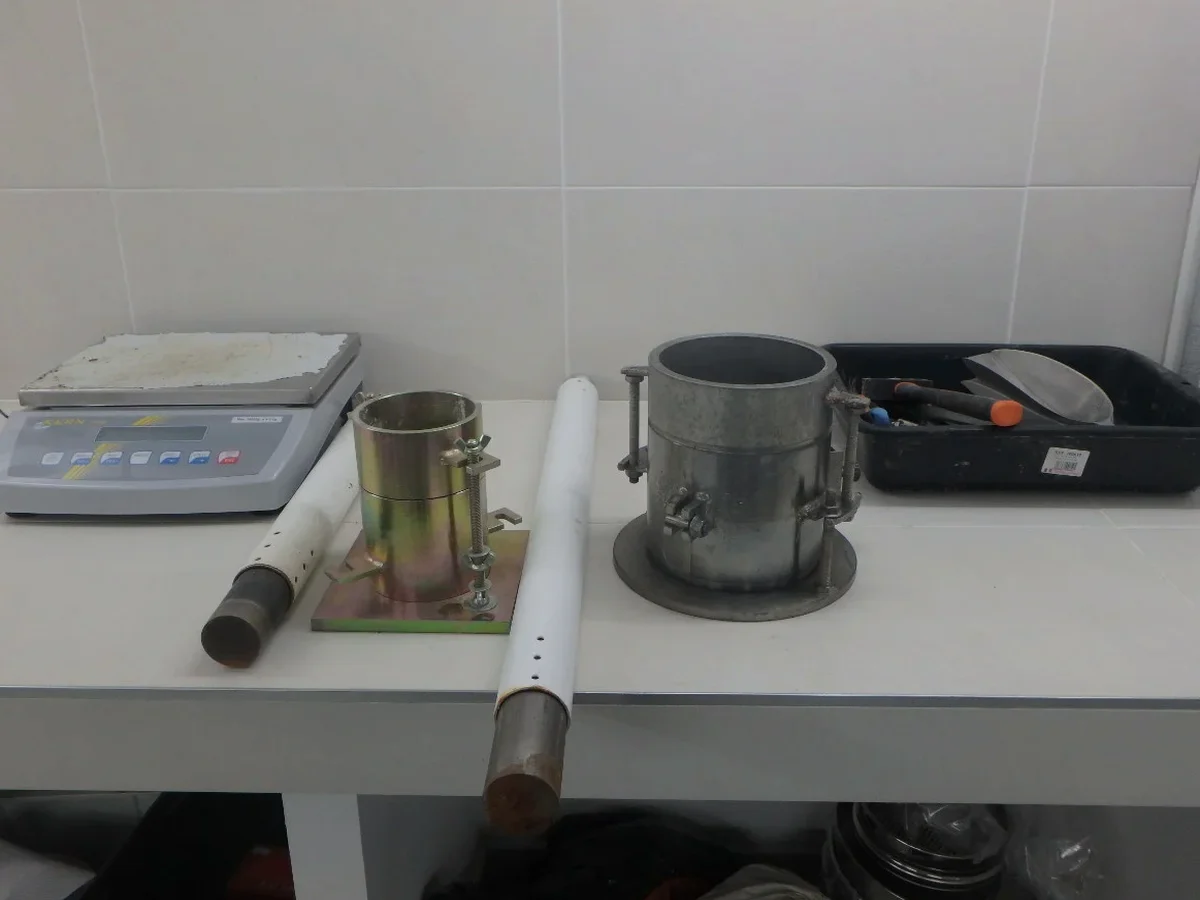
A road widening crew in Sydney hit a soft spot last spring. The fill they were placing just wouldn't compact. Turned out the native till from the Mira River valley had a moisture sensitivity nobody caught during the borrow source investigation. That's exactly why we run Proctor tests early, before the first load of fill arrives on site. The Proctor test establishes the moisture-density relationship for a specific soil: maximum dry density and optimum moisture content. In Cape Breton's variable terrain, where you can transition from well-drained glacial sands to marine silts within 200 meters, knowing the right compaction target makes the difference between a pavement that lasts 20 years and one that starts rutting after the first freeze-thaw cycle. We run the Standard Proctor per ASTM D698 when the spec calls for it, usually for residential pads and low-traffic roads. For heavy-load applications like container yards at the port or the runway overlay at J.A. Douglas McCurdy Airport, we switch to the Modified Proctor under ASTM D1557, which applies higher compactive effort matching modern equipment. When the borrow source is questionable, we pair the Proctor with a grain size analysis to confirm the classification, or with Atterberg limits if fine-grained soils are present and plasticity is a concern.
A 1% deviation from optimum moisture can drop field density by 5%, and in a Cape Breton winter that margin is the difference between stable pavement and frost heave.
Process and scope
Local context
Cape Breton sits on a complex mix of glacial tills, marine clays, and weathered bedrock from the Sydney Coalfield and Horton Group formations. The biggest compaction risk we see isn't the soil itself but the moisture condition at the time of placement. The island gets 1,400 mm of precipitation annually, spread across the year, so wet fill is a constant battle. A Proctor curve generated from a dried lab sample doesn't help if the contractor is placing material at 4% above optimum because it rained for three days straight. That's why our reports include a note on the moisture sensitivity of the curve and a recommended field moisture range, not just a single target number. Another risk specific to this region is the presence of pyritic shale in some borrow sources. When compacted and exposed to water and air, pyrite oxidizes to produce sulfuric acid, which attacks concrete and causes sulfate heave in stabilized layers. If the Proctor test is done on pyritic fill, the density numbers look fine but the long-term durability is compromised. We flag this when we see it and recommend chemical testing if the source is suspect.
Reference standards
The testing procedures conform to ASTM D698-12 and ASTM D1557-12 for standard and modified compaction, ASTM D2216 for moisture content determination, CSA A23.1 as the reference for concrete aggregates, and NBCC 2015 Division B Part 4 for structural design requirements.
Related services
Standard Proctor (ASTM D698)
For residential slabs, landscaping fills, and low-traffic roadways where compaction equipment is lighter. We use Method A for material passing the No. 4 sieve or Method C for soils with up to 30% retained on the 3/4-inch sieve.
Modified Proctor (ASTM D1557)
For highway embankments, airport pavements, industrial slabs, and port infrastructure where heavy rollers and high compactive effort are specified. Typically 56,000 ft-lbf/ft³.
Field Density Testing (Sand Cone)
We verify that the contractor is achieving the specified percentage of the lab maximum dry density. Performed with a sand cone density test, usually targeting 95% or 98% of Standard or Modified maximum.
One-Point Proctor (Field Quick Check)
When conditions change during placement and the lab curve is in doubt, we run a one-point field check to confirm the compaction curve hasn't shifted. Fast, practical, and keeps the job moving.
Typical parameters
Questions and answers
What is the difference between Standard and Modified Proctor?
The compactive effort. Standard Proctor applies 12,400 ft-lbf/ft³ using a 5.5-lb hammer dropping 12 inches. Modified Proctor applies 56,000 ft-lbf/ft³ using a 10-lb hammer dropping 18 inches. Modified produces a higher maximum dry density and a lower optimum moisture content. The choice depends on the project specification: residential and light commercial typically use Standard; highways, airports, and heavy industrial use Modified.
How long does a Proctor test take in Cape Breton?
From receiving the sample to delivering the final report, allow 3 to 5 business days for a full multi-point curve. We can expedite to 48 hours for urgent projects. The limiting factor is oven-drying time for moisture content determination at each compaction point.