The northern highlands of Cape Breton are underlain by a patchwork of dense glacial till, fractured granite of the Cape Breton Highlands massif, and soft estuarine silts in the Bras d'Or lowlands. Designing a raft foundation here means confronting bearing capacities that can swing from 150 kPa to over 500 kPa within a single site boundary. The frost penetration depth routinely exceeds 1.4 metres in the interior plateau, and the 2020 NBCC spectral accelerations for the Sydney–Glace Bay corridor demand a rigorous check of soil–structure interaction for any mat-supported building. We pair site-specific geophysics with targeted test pits to map the till–bedrock interface, and run Atterberg limits on the clay-rich lenses that appear unpredictably in the Mira River valley.
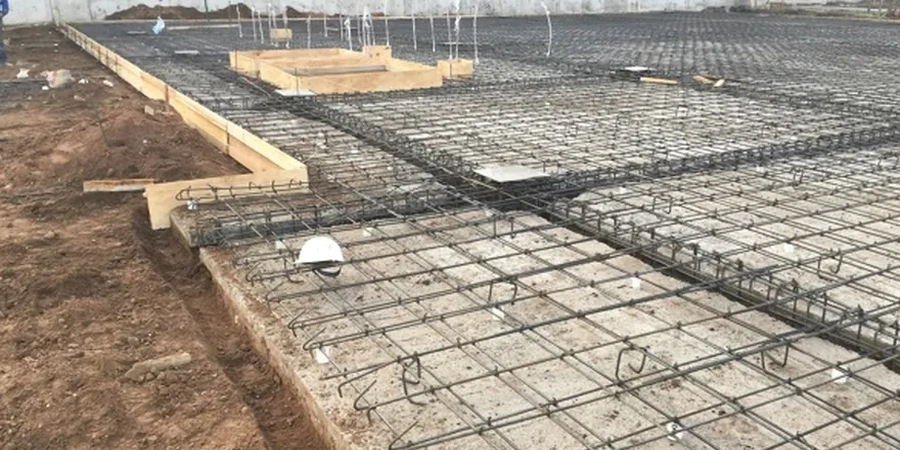
A raft foundation in Cape Breton must be thick enough to resist frost jacking and stiff enough to span the soft lenses buried in the glacial till.
Process and scope
Local context
The survey crew arrives in Cape Breton with a truck-mounted drill rig and a dynamic cone penetrometer, ready to push through the boulder-strewn till that defeats lightweight equipment. The primary risk is differential settlement across a single mat footprint: a rigid raft bridging from a granite pinnacle onto a pocket of compressible silt can develop diagonal cracking within the first five freeze–thaw seasons. We map the depth to refusal every 5 metres on a staggered grid, and where the refusal plane dips more than 1:10, we specify a deepened excavation with a compacted structural fill wedge to create a uniform bearing stratum. A second risk is frost heave lifting unheated perimeter areas; we mitigate it by extending the edge beam 200 mm below the local frost line and placing a continuous layer of extruded polystyrene insulation beneath the slab.
Reference standards
The design shall adhere to NBCC 2020 (Division B, Part 4), CSA A23.3:19 – Design of Concrete Structures, and ASTM D1194 – Standard Test Method for Bearing Capacity of Soil.
Related services
Subgrade investigation and modulus testing
SPT borings, plate load tests, and DCP profiling to determine the modulus of subgrade reaction at multiple grid points across the building footprint.
Seismic soil–structure interaction analysis
NBCC 2020-compliant response spectrum analysis with site class determination per Table 4.1.8.4.A, including liquefaction screening where applicable.
Raft thickness and reinforcement design
Finite element modeling of the mat as a plate on elastic springs; output includes bending moment envelopes, shear diagrams, and CSA A23.3 bar schedules.
Frost protection and drainage detailing
Edge beam geometry, underslab insulation layout, and perimeter drain design to keep the bearing stratum free of ice lens formation.
Typical parameters
Questions and answers
How much does a raft foundation design cost for a Cape Breton project?
Does the NBCC require a specific raft thickness?
The NBCC does not prescribe a fixed thickness. It requires that the foundation be designed to resist all applied loads without exceeding the allowable bearing pressure and that frost protection extends to the depth specified in the local climate data tables. We determine the thickness through structural analysis based on the modulus of subgrade reaction and the column loads.
Can a raft foundation be used on the steep slopes around the Bras d'Or Lake?
Yes, but only when combined with a stepped or deepened excavation that keys into competent till or bedrock. On slopes steeper than 1:4, we typically integrate the raft with a retaining structure and perform a global stability analysis to confirm the factor of safety exceeds 1.5 under long-term conditions.
What site class is most common in Cape Breton?
Most sites fall into Site Class C (dense till, very dense sand) or Site Class B (shallow bedrock). In the lowlands near river mouths, you often encounter Site Class D profiles with soft silt layers that require a site-specific response analysis.