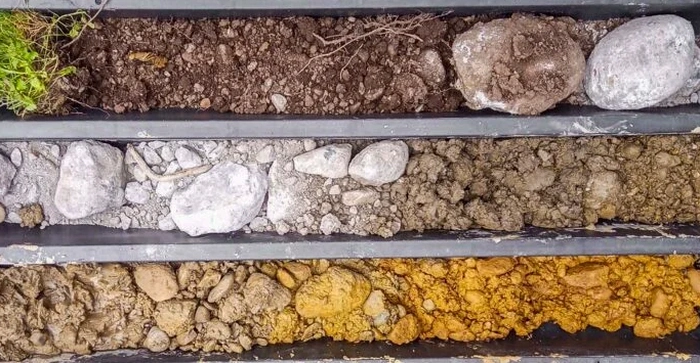
Cape Breton’s glacial history left a complicated mix of till, weathered bedrock and marine silts. On a recent project near Sydney River, we hit refusal at less than 1.2 m in what the desktop study called ‘dense sand’. It was sandstone bedrock. That’s why an exploratory test pit matters here. You need to see the stratigraphy with your own eyes. Our crews open pits from 1.5 to 4.5 m depth using mechanical excavators. We log moisture, color, consistency and any seepage immediately. In areas with soft clays we often coordinate with footings design to confirm bearing depth in one visit. No guesswork.
A test pit in Cape Breton reveals what boreholes miss: the real contact between glacial till and bedrock, visible in less than two hours.
Process and scope
Local context
Sites in Sydney can sit on dense till while Glace Bay deals with compressible silts and old mine backfill. Different worlds, same island. We’ve seen projects where the geotech report assumed uniform conditions, but two test pits 30 m apart showed completely different fill thickness. That mismatch blows budgets. An exploratory test pit catches those transitions early. You see the fill. You see the organics. You see where the water table really sits. No interpolation errors. For contractors, that means accurate earthwork quantities. For owners, it means no surprises when the footing forms go in.
Reference standards
ASTM D2488 provides visual-manual soil description, CSA A23.3 governs concrete structures for backfill evaluation, NBCC 2015 outlines geotechnical requirements, and ASTM D420 guides site characterization.
Related services
Field logging and photography
We log stratigraphy on site using the ASTM D2488 system. Each layer gets a photograph with scale reference and a field description of moisture, plasticity and color. The log sheet includes pit coordinates, date and the name of the logging technician.
Disturbed and block sampling
Bulk samples are taken from each distinct layer for laboratory classification. Where cohesive soils are present, we cut block samples for undrained strength testing. Sample chain of custody follows our ISO 17025 accredited laboratory procedures.
Typical parameters
Questions and answers
How much does an exploratory test pit cost in Cape Breton?
How long does it take to excavate and log one test pit?
A single pit to 3.5 m depth typically takes 1.5 to 2.5 hours for excavation, logging and backfill. The field log and photos are delivered the same day.
What safety measures do you follow during excavation?
We follow CSA requirements for excavation safety. Pits deeper than 1.5 m are benched or shored. The excavator operator stays with the machine, and no personnel enter the pit without a competent person’s approval and adequate protective systems in place.
Can you take samples from the test pit for lab testing?
Yes. We collect bulk disturbed samples from each soil layer as standard. If the soil is cohesive and undisturbed strength is needed, we cut block samples and transport them in sealed containers to our accredited laboratory.
What happens when bedrock is hit before the planned depth?
We stop excavation at refusal, photograph the bedrock surface, measure the depth and note fracture spacing and weathering. If deeper investigation is needed, we recommend switching to an spt-drilling program to core or sample the rock.