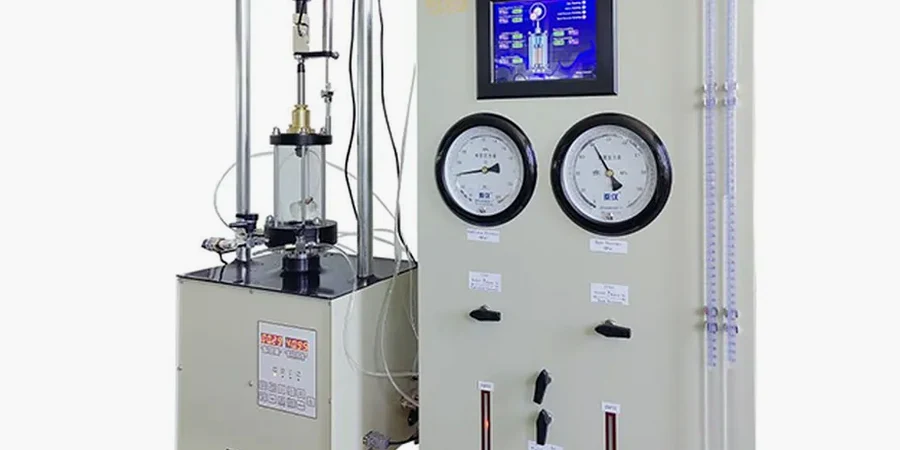
Cape Breton’s coastal geology demands a different level of care when it comes to soil strength testing. Between the ancient granitic bedrock of the Cape Breton Highlands and the thick glacial tills blanketing the Bras d’Or Lake region, the stress history and drainage behavior of local formations can shift dramatically from one site to the next. A standard unconfined test simply cannot capture how a saturated till will behave under long-term loading once pore pressures begin to dissipate. The triaxial test provides that missing piece: controlling both confining stress and drainage path so the engineering team can extract friction angles and cohesion values that actually reflect field conditions. When we work on harbourfront structures in Sydney or slope cuts along the Cabot Trail, the team often pairs triaxial data with in-situ permeability tests to understand how quickly water moves through the formation, and with slope stability analysis where the failure envelope directly governs the factor of safety.
A single triaxial test on a carefully preserved Shelby tube sample gives more usable strength data than a dozen pocket penetrometer readings on a weathered outcrop.
Process and scope
Local context
The most common mistake we see in Cape Breton is a designer applying generic friction angles from a textbook correlation—say, 32 degrees for a 'sandy till'—without realizing the local till contains enough silt to behave more like a low-plasticity clay when saturated. You get a retaining wall or slope cut that looks fine on paper but starts creeping after the first heavy October storm. A proper triaxial program catches that mismatch early. Another recurring issue involves consolidation stress. If the lab tests the specimen at a confining pressure that does not reflect the actual overburden, the resulting Mohr envelope will be shallow and unconservative. Our protocol always references the field stress profile supplied by the geotechnical engineer, and we run at least three confining stages to define the envelope properly. Skipping triaxial testing on critical infrastructure—bridges, deep sewer excavations, wind turbine bases—is a gamble that the glacial geology here rarely rewards.
Reference standards
ASTM D4767-11 (CIU Triaxial Compression Test), ASTM D2850-15 (UU Triaxial Compression Test), ASTM D7181-20 (CID Triaxial Compression Test), CSA A23.3 (Concrete Design, relevant for foundation interfaces), and NBCC 2015 (National Building Code of Canada, geotechnical references) are the applicable standards.
Related services
Consolidated-Undrained (CIU) Triaxial with Pore Pressure
The workhorse for saturated fine-grained soils in the Sydney basin. We consolidate each specimen to the target effective stress, then shear undrained while recording pore pressure to generate effective stress strength parameters.
Consolidated-Drained (CID) Triaxial for Long-Term Stability
Used when drained conditions control the design, such as permanent retaining structures or very slow excavations in permeable till. Shear rate is kept low enough for pore pressure equilibration throughout the test.
Unconsolidated-Undrained (UU) Quick Triaxial
A rapid total-stress assessment suitable for preliminary design or for clay layers where in-situ saturation is very high. Often run in parallel with CIU suites to bracket the strength envelope for staged projects.
Typical parameters
Questions and answers
How much does a triaxial test program cost for a Cape Breton project?
What is the difference between total stress and effective stress triaxial parameters?
Total stress parameters c and φ describe the soil's strength without separating pore water pressure effects. Effective stress parameters c' and φ' strip out the pore pressure and represent the actual friction and cohesion between soil particles. For any Cape Breton project involving saturated silts or clays, effective stress parameters are essential because pore pressures change during loading and consolidation.
How should soil samples be handled before triaxial testing?
Undisturbed samples from Shelby tubes must be sealed immediately after extrusion, kept at field moisture content, and transported without freezing or vibration. The team should never let the tube ends dry out during shipping. Our lab inspects every tube for disturbance cracks before trimming the specimen, and we reject samples that show obvious remolding or desiccation.
Can you run triaxial tests on remolded or compacted specimens?
Yes. For fill quality control or borrow source evaluation, we compact specimens to a specified density and moisture content, then run drained or undrained triaxial tests. This is common for engineered fills under footings or embankments where the client needs to confirm that the placed material will achieve the design strength after compaction.